|
Biochemistry of Meiotic Recombination
Analysis of the structural architecture of meiotic recombination complexes
Characterization of the mechanism of homolog bias in meiosis
Role of Rad51 in genome stability and cancer
Small molecule stimulators of Rad51-DNA binding
A unique property of meiotic recombination in budding yeast is that recombination occurs between homologous chromatids (i.e. between maternal and paternal chromatids) rather than between sister chromatids (i.e. between two maternal or two paternal chromatids). Meiotic recombination bias differs dramatically from mitotic bias which strongly favors recombination between sister chromatids. We use a 2D gel electrophoresis method developed in the laboratory of Nancy Kleckner at Harvard, as well as other methods, to study the mechanism of homolog bias. For example, in collaboration with Neil Hunter’s group at U.C. Davis, we used the 2D gel approach to show that Rad51 and Dmc1 must cooperate to achieve homolog bias (Lao et al. 2014).
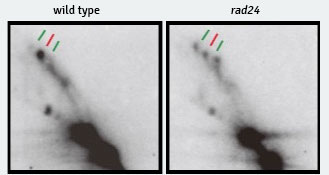
2-D gel analysis of the role of checkpoint protein Rad24 in meiotic homolog bias. The positions of double Holliday junction recombination intermediates that connect sister chromatids are shown. The interhomolog double Holliday junction signal is indicated by a red dash, the two intersister double Holliday junction signals are indicated by green dashes (Shinohara et al. 2015). Interhomolog molecules predominate in wild type, whereas the two intersisters species, and the interhomolog species, are seen at similar levels in the rad24 mutant. The result shows that Rad24 promotes homolog bias in wild type cells.
Shinohara, M., Hayashihara, K., Grubb, J.T., Bishop, D.K., and Shinohara, A. (2015) DNA damage response clamp 9-1-1 contributes to chromosomal assembly of ZMM/SIC proteins for formation of crossovers and synaptonemal complex during meiosis. J. Cell Science, doi: 10.1242/jcs.161554
Lao, J.P., Cloud, V., Huang, C.-C., Grubb, J., Thacker, D., Lee, C.-Y., Dresser, M.E., Hunter, N., and Bishop D.K. (2013) Meiotic Crossover Control by Concerted Action of Rad51-Dmc1 In Homolog Template Bias And Robust Homeostatic Regulation. PLOS Genetics 9, e1003978
page top
|


 Projects